
Your AI Assistant Is About to Become an AI Operator
For the last few years, "AI assistant" has meant something fairly narrow: a chat box that answers questions, drafts text, and offers suggestions. You ask, it tells. The work of actually doing something — filling out the form, booking the flight, updating the spreadsheet, logging into the portal — stayed with you. That boundary is dissolving. Across the industry, the same AI models that used to just talk are now reaching for a mouse and keyboard. They read a screen, decide what to click, type into fields, and complete multi-step tasks with no human steering the wheel in real time. The shift has a name in the industry: going from assistant to operator — from a system that advises to a system that acts. This isn't a distant forecast. It's already running in browsers, back offices, and developer tools today.
From Assistant to Operator: What’s Actually Changing
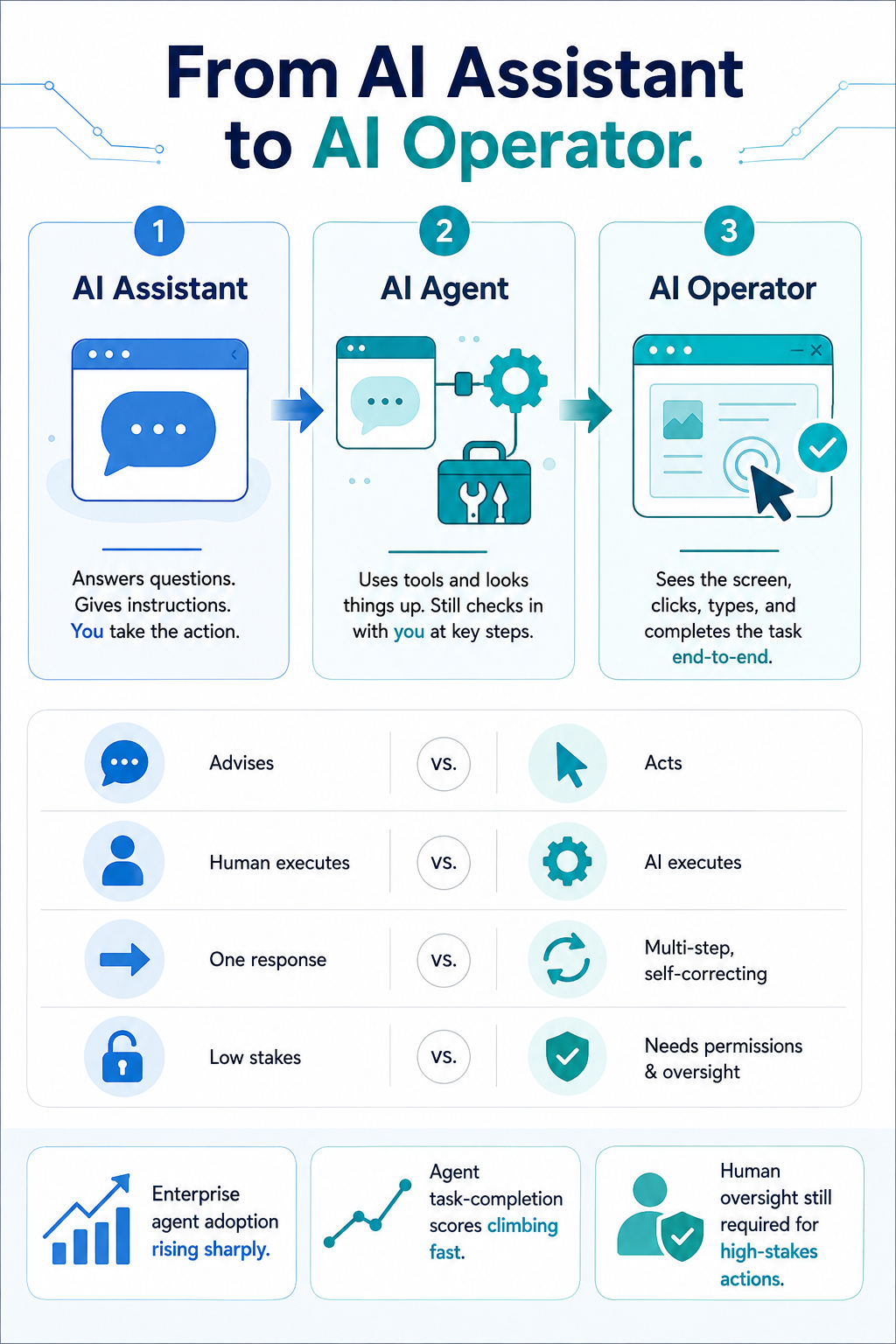
The difference between an assistant and an operator comes down to one question: who executes the action?
- An assistant tells you how to cancel a subscription. An operator logs into the account and cancels it.
- An assistant drafts a reply to a supplier email. An operator finds the invoice, checks it against the purchase order, and sends the reply.
- An assistant explains how to file an expense report. An operator opens the finance portal, uploads the receipt, and submits it. What made this possible is a combination of three capabilities converging at once:
- Screen and interface understanding. Models can now interpret a live screen or webpage — not just text, but buttons, menus, and layout — well enough to navigate it the way a person would.
- Multi-step planning and error recovery. Instead of executing one command and stopping, operators plan a sequence of actions, notice when something goes wrong (a pop-up, a redesigned page, a failed login), and adjust.
- Standardized tool connections. Protocols that let AI systems plug into external tools, apps, and other agents — rather than being hand-coded for each one — mean operators can be extended to new tasks far faster than traditional automation ever could. The result is software that treats your computer, browser, or business applications the way a competent new employee would: by looking at what’s on screen and figuring out what to do next.
The Technology Behind the Shift
A few converging developments explain why this is happening now rather than five years ago:
Computer- and browser-use models. Rather than depending on custom integrations, newer AI systems can perceive a screen and directly control the mouse and keyboard, or read a webpage’s underlying structure to click and type with precision. This lets the same model handle Salesforce today and a government tax portal tomorrow, without a developer writing a connector for either.
Agent protocols. Open standards for letting AI systems call tools, share context, and talk to other agents have matured quickly, making it far easier to chain an operator into an existing software stack instead of rebuilding that stack around it.
Dedicated agentic browsers. Several browser makers have shipped or previewed browsers with agent modes built in, so the operator isn’t a bolted-on extension but a native part of how the browser works — holding your logged-in sessions, cookies, and tabs, and acting inside them directly.
Multi-agent orchestration. Rather than one general-purpose operator doing everything, organizations increasingly run small teams of specialized agents — one for research, one for data entry, one for communications — coordinating on a single task the way departments hand work to each other.
Together, these have pushed AI operators out of research demos and into daily use for research, shopping, scheduling, and back-office data entry, with enterprise adoption climbing sharply through 2026 as reliability and cost have improved.
Where Operators Are Already at Work
The shift shows up in ordinary tasks first:
- Web research. Instead of manually visiting a dozen sites, an operator is told to research a topic and returns a compiled, structured summary — a task that used to eat hours out of an analyst’s week.
- Shopping and price tracking. Operators can monitor prices across retailers, flag drops, and in some cases complete a purchase automatically once a condition is met.
- Travel booking. A single instruction — find a flight under a certain price by a certain date — turns into a fully executed booking, with the agent comparing options and filling out forms itself.
- Back-office automation. In small and mid-sized businesses, operators are increasingly handling repetitive portal work — supplier orders, tax filings, ERP data entry — tasks that used to require either manual effort or brittle, code-based automation that broke every time a website changed its layout.
- Software development. Coding agents now handle a substantial share of routine development work, though most organizations still keep a human reviewing and approving before changes ship. The common thread: these are tasks with a clear goal and a somewhat repeatable path, where a model that can see a page and act on it beats both manual effort and older scripted automation, which tends to break the moment a website redesigns.
The New Risks: Trust, Security, and Accountability
Handing an AI system the ability to act — not just advise — changes the risk profile substantially.
Prompt injection. An operator browsing the live web can encounter malicious instructions hidden in a page, an email, or a document, and mistake them for legitimate commands. Because the agent often carries your logged-in session and identity, a successful injection doesn’t just produce a bad answer — it can take a bad action on your behalf.
Credential and permission scope. Giving an operator access to accounts raises the obvious question of how much it should be trusted with. Common practice among vendors and businesses deploying these systems includes using scoped or temporary credentials, running agents in isolated environments, keeping detailed audit logs, and explicitly withholding autonomous access to anything irreversible — sending money, deleting data, or messaging on your behalf — without a human sign-off step.
Reliability gaps. Even the best-performing operators still fail on complex, dynamic, or unusual pages, and industry watchers caution against treating “AI agent” marketing claims at face value — a genuinely agentic system reasons and adapts when a task changes mid-stream; many labeled “agents” are closer to a chatbot bolted onto a fixed script.
Accountability. When an operator books the wrong flight or submits an incorrect form, the question of who is responsible — the user, the developer, or the platform — is still being worked out in practice, not just in policy documents.
None of this makes the technology unsafe to use. It does mean operators are best deployed with clear boundaries: narrow scopes, human approval on high-stakes actions, and logging that lets you see exactly what the system did and why.
How to Prepare
If you’re an individual user:
- Start with low-stakes, easily reversible tasks — research, price comparisons, drafting — before granting an operator access to accounts that touch money or personal data.
- Use dedicated or limited-permission accounts where possible, rather than your primary email or banking credentials.
- Keep a human-in-the-loop step for anything irreversible. If you’re a business:
- Treat operator deployments as you would any new system with access to customer or financial data: scoped credentials, sandboxed environments, and audit trails from day one.
- Pilot in a narrow, well-defined workflow before expanding scope — the highest-value early wins tend to be repetitive, well-understood tasks rather than open-ended ones.
- Expect to run several specialized agents rather than one do-everything system, and plan for how they’ll coordinate.
The Road Ahead
The move from assistant to operator is less a single product launch than a steady widening of what AI systems are allowed to touch. Chat interfaces aren’t disappearing — plenty of tasks are still best served by a conversation. But increasingly, that conversation is the start of the interaction, not the whole of it. You’ll describe an outcome; the system will handle the clicking.
The organizations and individuals who benefit most from this shift will likely be the ones who treat it the way you’d onboard a new hire with real access to your systems: give clear instructions, start with limited scope, and build up trust — and safeguards — as the track record grows.
Sources
- AI Browser Automation Agents Guide — AIToolsReview
- Agentic Computer Use: Deep Guide 2026 — o-mega
- AI Computer Use Benchmarks 2026 — o-mega
- AI Browser Automation 2026 — ZTABS
- AI Browser Agents in 2026: SMEs — ACTGSYS
- The Agentic Browser Landscape in 2026 — No Hacks
- AI Browser Agents: The New Automation Layer — Fordel Studios
- Belitsoft AI Agent Development Forecast 2026 — Barchart
- Belitsoft: Enterprises run 12 AI agents on average — Barchart
NEED CUSTOM
ENTERPRISE
ARCHITECTURE?