
Why 73% of Companies Automating With AI Agents Are Quietly Outpacing You
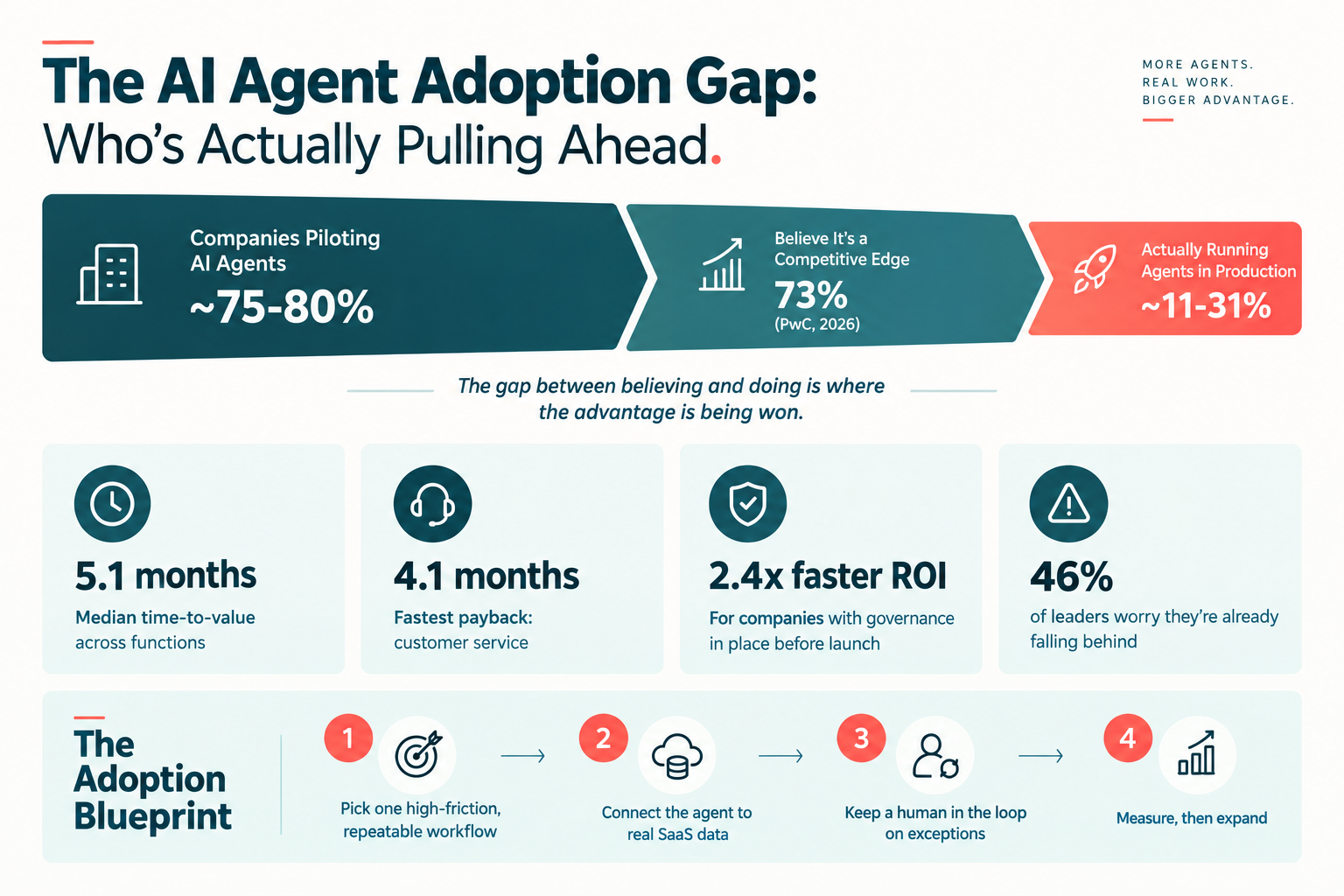
Somewhere in your industry right now, a competitor has quietly handed off lead qualification, invoice processing, or first-line customer support to an AI agent that runs without anyone babysitting it. They didn't announce it. There was no press release. But their sales cycle got a little shorter, their support backlog got a little thinner, and their operating costs got a little leaner — and those small compounding advantages are starting to show up in win rates and margins. According to PwC's 2026 AI Agent Survey, 73% of business leaders agree that how they use AI agents will give them a significant competitive advantage over the next 12 months, and 75% say they're confident in their company's AI agent strategy. That confidence isn't idle optimism — it's backed by real deployment. The uncomfortable follow-on finding: 46% of respondents worry their own company may already be falling behind competitors on AI agent adoption. That's the quiet part of this story. The gap is opening now, while it's still small enough to close.
What “AI Agent” Actually Means (And Why It’s Different This Time)
The term “AI agent” has been stretched to cover everything from a chatbot with a new coat of paint to a fully autonomous system that plans, decides, and executes multi-step work. The distinction matters, because only one of those categories is actually moving the needle.
A genuine AI agent doesn’t just answer a question — it takes the next step. It reads an incoming support ticket, checks the customer’s order history, decides whether a refund is warranted under policy, processes it, and logs the resolution — without a human clicking through each stage. Built on top of the SaaS infrastructure companies already run (CRMs, ticketing systems, ERPs, communication platforms), these agents act inside tools your team already trusts, rather than requiring a parallel system nobody adopts.
This is what separates the current wave from the RPA and chatbot automation of the last decade: agents reason through ambiguity and adapt when a process doesn’t go exactly as scripted, instead of breaking the moment reality deviates from the flowchart.
The Numbers Behind the Shift
The data paints a consistent picture of fast-moving, uneven adoption:
- Adoption is nearly universal at the pilot stage. Multiple 2026 surveys put the share of enterprises that have adopted AI agents in some form between roughly 70% and 80%, with McKinsey reporting that 72% of organizations worldwide have adopted at least one AI-based automation solution.
- Production deployment is far more concentrated. Despite broad experimentation, one 2026 analysis found that only about 11% of enterprises are actually running AI agents in production, with LangChain’s research separately finding just 51% of organizations have agents running in production at all — meaning many “adopters” are still stuck at the pilot stage.
- Where it works, the payback is fast. BCG and Forrester research cited in one 2026 industry roundup found a median time-to-value of 5.1 months across functions, with sales-development agents paying back in as little as 3.4 months.
- Customer service leads the pack. One analysis found customer service offers the shortest payback period, at roughly 4.1 months, making it the most common starting point for enterprise agent deployments.
- The leaders separate fast. The same research found that companies which put governance frameworks, baseline metrics, and clear business ownership in place before deploying reach positive ROI 2.4 times faster than those that don’t.
The pattern across nearly every credible study is the same: adoption is nearly universal, but production-grade, value-generating adoption is still a minority position — which is exactly why the companies that get there first pull ahead.
Where the Advantage Actually Shows Up
Compressed cycle times. Tasks that used to move through a queue — ticket triage, lead qualification, invoice matching, first-pass contract review — now resolve in minutes because an agent handles the repeatable parts and escalates only genuine exceptions to a person.
Lower cost per transaction. Research cited by industry analysts has found agentic customer-interaction automation can cut related operational costs dramatically in mature deployments, freeing budget that would otherwise scale linearly with headcount.
Faster, more consistent decisions. Agents built on top of live business data — a CRM record, an inventory system, a support history — make judgment calls grounded in current information rather than a static playbook, and they make the same call the same way every time.
Compounding operational leverage. Every workflow successfully handed to an agent frees human attention for the judgment calls, relationship work, and edge cases that still need it — and that reallocation, repeated across dozens of workflows, is where the real competitive gap opens up.
The Blueprint: Adopting Agentic Workflows Before the Window Closes
Companies that successfully move from pilot to production-grade agent deployment tend to follow a similar sequence, whether they’re a 20-person startup or a global enterprise.
1. Start with one high-friction, well-defined workflow — not a company-wide rollout. The teams that struggle are the ones trying to automate ten processes at once before proving that even one delivers consistent value. Customer service, lead qualification, and back-office data processing are consistently the fastest, lowest-risk places to start, since the data is structured and the success criteria are easy to measure.
2. Build on the SaaS infrastructure you already have. The fastest path to production isn’t a from-scratch build — it’s connecting an agent platform to the CRM, helpdesk, or ERP your team already trusts. Platforms like Salesforce Agentforce (CRM-native, strong for customer-facing workflows), Microsoft Copilot Studio (best for teams standardized on Microsoft 365), and developer-oriented frameworks like LangGraph or CrewAI (for custom, cross-system workflows) each fit a different starting point — the right choice usually maps to whichever ecosystem your operational data already lives in.
3. Name an owner and set measurable success criteria before launch. Deployments with a named business owner, a defined baseline metric, and clear scope reach positive ROI meaningfully faster than deployments where “AI agents” is everyone’s responsibility and no one’s in particular.
4. Keep a human in the loop on exceptions and high-stakes actions. The organizations avoiding costly failures are consistently the ones that pair agent autonomy with tested guardrails and human review on anything irreversible — refunds above a threshold, contract commitments, anything touching sensitive data — rather than treating full autonomy as the goal from day one.
5. Measure relentlessly, then expand deliberately. Once a workflow is generating measurable value, use that evidence — and that operational muscle — to identify the next-best candidate, rather than trying to scale everything simultaneously.
The Honest Caveats
This isn’t a story where every company that touches AI agents wins automatically. Several sobering data points are worth sitting with before diving in headfirst:
- A meaningful share of agent projects get abandoned. Industry forecasts have suggested that a substantial percentage of agentic AI projects will be shelved by the end of 2027 due to unclear value, rising costs, or inadequate risk controls — a pattern that shows up most often when companies skip the governance and measurement steps above.
- “Agent washing” is real. A large share of products marketed as AI agents are, on closer inspection, repackaged chatbots or scripted automation without genuine autonomous reasoning — worth scrutinizing carefully during vendor evaluation.
- Trust in full autonomy is actually declining among leaders, even as adoption grows — most organizations are converging on agents that act with human oversight on higher-stakes decisions, not full unsupervised autonomy.
- Governance maturity is lagging adoption. Only a minority of organizations report having a mature governance model for agentic AI in place, which is precisely the gap that separates the companies compounding an advantage from the ones accumulating risk.
None of this argues against adopting agentic workflows — it argues for adopting them deliberately, with the governance and measurement discipline that separates the 73% who believe in the advantage from the smaller group actually capturing it.
Conclusion
The competitive gap being described here isn’t hypothetical, and it isn’t loud. It’s showing up in shorter cycle times, lower cost per transaction, and freed-up human attention at companies that moved past the pilot stage while others were still debating whether to start. The PwC data is blunt about the stakes: nearly half of business leaders already suspect they’re falling behind. The companies quietly pulling ahead aren’t necessarily the ones with the flashiest AI strategy — they’re the ones who picked one real workflow, built it on infrastructure they already trust, put a human and a metric behind it, and started before the advantage became table stakes instead of an edge.
Sources
- PwC’s AI Agent Survey
- AI Agents Statistics 2026: Adoption, Market Growth and Key Trends — Citrusbug
- AI Agents Statistics 2026: Market Size & Adoption — GetPanto
- AI Agent Statistics 2026: Adoption Rates, ROI Data — SaaSUltra
- AI Agent Adoption 2026: 120+ Enterprise Data Points — Digital Applied
- The State of Automation and AI-Agent Adoption 2026 — Uplift
- 60+ AI Agent Statistics for Businesses 2026 — WotNot
- Best Enterprise Level Agentic AI Platforms for 2026 — MarkTechPost
- 10 Best Agentic AI Platforms for SaaS Teams in 2026 — Guideflow
NEED CUSTOM
ENTERPRISE
ARCHITECTURE?