
The Hidden GPU Shortage That Could Freeze Your AI Roadmap in 2026
Most teams building AI products in 2026 expected their biggest obstacle to be the models themselves — accuracy, hallucinations, integration work. Instead, a quieter constraint has been stalling roadmaps: there simply isn't enough compute to go around. Training runs get pushed back. Reserved GPU pools are locked up months in advance. Pricing shifts without warning. For a growing number of teams, the bottleneck isn't the AI. It's the hardware underneath it. This isn't a temporary blip that resolves itself by next quarter. It's a structural shortage running through chips, memory, and power infrastructure at once — and understanding its actual shape is the first step to planning around it instead of being blindsided by it.
It’s Not Just “Not Enough GPUs”
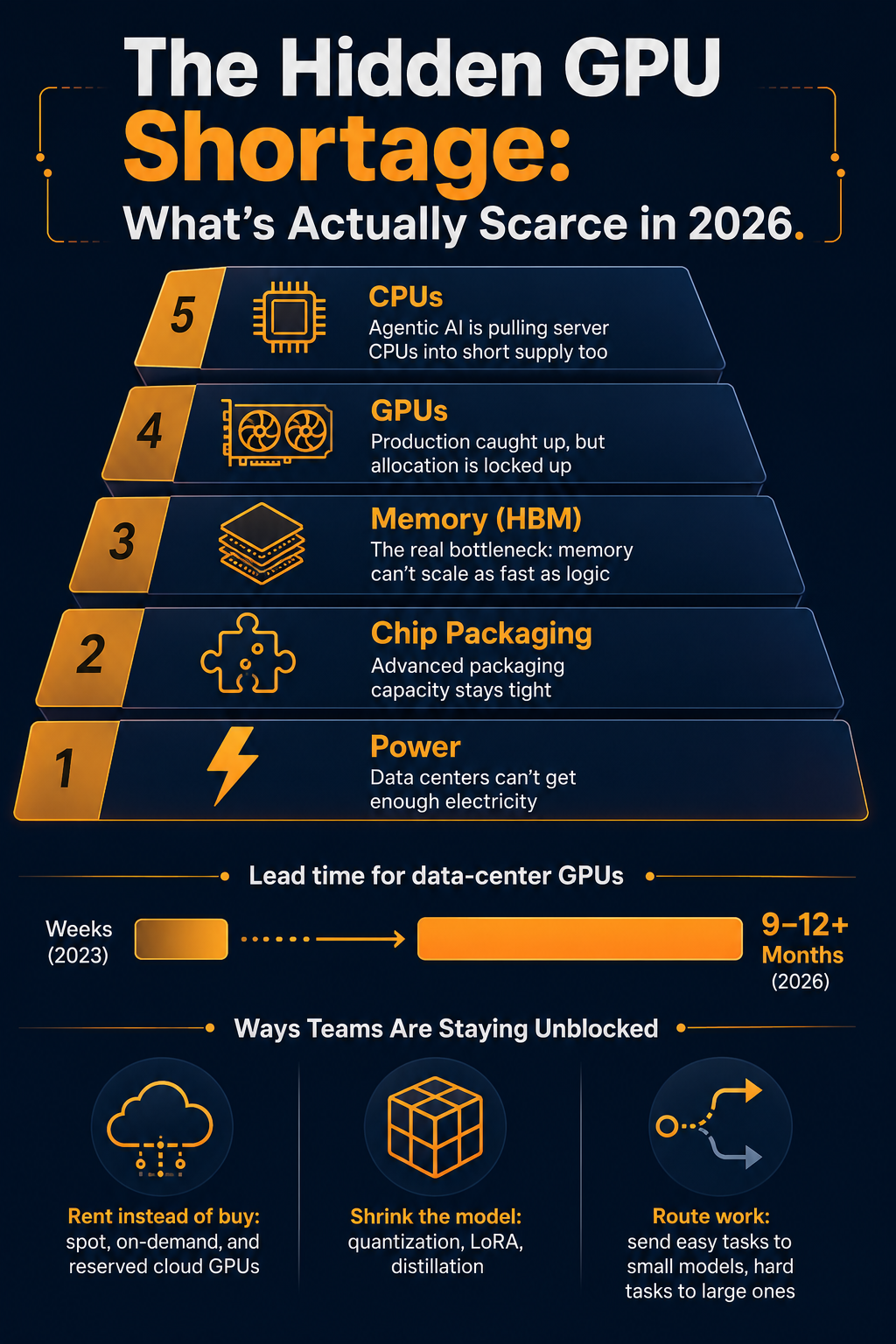
The shorthand “GPU shortage” undersells what’s actually happening. By 2026, the constraint has spread across an entire stack of scarce layers, and a delay in any one of them can turn an approved project into a stalled pilot.
Chip production caught up — memory didn’t. NVIDIA and TSMC have scaled logic-chip manufacturing significantly since the early Hopper-era crunch. But high-bandwidth memory (HBM) — the specialized memory stacked directly onto AI accelerators — has not kept pace. HBM is made by only a handful of suppliers, using a manufacturing process that is far harder to scale quickly than logic production, even with tens of billions of dollars in new investment flowing in. Since memory makers can charge more selling to AI hyperscalers than to consumer graphics card makers, memory increasingly flows toward AI data centers first, squeezing everyone else.
Consumer hardware is absorbing the fallout. The memory crunch has gotten so severe that GPU makers have cut consumer graphics card production, and some 2026 consumer chip lines have reportedly been delayed or shelved entirely as manufacturers redirect memory toward higher-margin AI accelerators.
CPUs joined the shortage too. As AI workloads have become more “agentic” — involving orchestration, retrieval pipelines, and multi-step reasoning rather than a single inference call — the demand for general-purpose server CPUs has spiked alongside GPU demand. Lead times that used to run a couple of weeks have stretched to two or three months for some server chips, catching teams that budgeted only for GPU costs off guard.
Packaging and power add further friction. Advanced chip packaging capacity, while easing compared to a couple of years ago, remains tight, and data center power availability has become one of the least visible but most binding constraints on how quickly new AI capacity can come online at all.
The result: lead times measured in months, not weeks. Data-center GPU lead times have run anywhere from roughly nine months to a year in 2026, and reserved cloud capacity is frequently booked six or more months in advance. Teams that assumed they could “add compute when they need it” are increasingly finding that assumption doesn’t hold.
How This Actually Freezes a Roadmap
The shortage doesn’t usually show up as a dramatic outage. It shows up in quieter, more frustrating ways:
- Training runs get delayed, not because the model isn’t ready, but because the reserved GPU pool a team was counting on is locked behind existing customers with longer-term contracts.
- Prices move without notice. Hourly rental rates for top-tier GPUs have swung by 40% or more within a matter of weeks during periods of acute scarcity, and cloud providers have quietly raised on-demand pricing on capacity-constrained instance types.
- Quota denials replace outright unavailability. Rather than being told “sold out,” teams increasingly hit API-level quota limits, regional capacity constraints, or a sales conversation nudging them toward a different, more expensive architecture.
- Access concentrates among well-funded players. Hyperscalers and frontier labs with the ability to sign large forward contracts have effectively locked up much of the available allocation, leaving mid-market and early-stage teams competing for what’s left.
- Even hosted-AI users feel it indirectly. Teams that never touch a GPU directly — just calling a hosted model API — still feel the shortage through rate limits, usage caps, and less predictable pricing from their AI vendor, since the scarcity flows through the entire supply chain.
For a startup or mid-sized engineering team, the practical effect is the same regardless of the cause: a roadmap built around “we’ll scale compute when we need it” is running into walls that a roadmap built around “we’ve planned our compute access in advance” isn’t.
Cloud GPU Rental: Keeping the Roadmap Alive Without Buying Hardware
Buying GPU hardware outright is not a realistic option for most teams — the capital cost is steep, delivery can take the better part of a year, and the hardware depreciates fast as newer chip generations arrive. Renting compute has become the default path forward, but “the cloud” isn’t one option — it’s several, with very different price-reliability tradeoffs.
Hyperscalers (AWS, Google Cloud, Azure). These offer the broadest ecosystem, compliance certifications, and guaranteed capacity — at a real premium. On-demand pricing for top-tier GPUs on hyperscalers has commonly run several times higher per hour than specialized alternatives, and reserved “capacity block” pricing has moved upward during 2026 as demand has tightened.
Specialized GPU clouds (CoreWeave, Lambda Labs, Nebius, and similar). Built specifically for AI workloads, these providers typically undercut hyperscaler on-demand rates while still offering solid reliability — a middle ground that suits teams running consistent training or inference workloads without wanting hyperscaler overhead.
Peer-to-peer and marketplace platforms (Vast.ai, io.net, and similar). These aggregate spare capacity from a wide range of hosts, often at the lowest headline prices — but with real tradeoffs: variable reliability, less predictable availability, and the risk of a spot instance being reclaimed mid-job. They tend to work best for experimentation, non-critical runs, or workloads that can tolerate interruption.
A practical framework for choosing:
- On-demand billing suits unpredictable or bursty workloads where flexibility matters more than the lowest possible rate.
- Spot/marketplace pricing suits non-critical training runs, experimentation, and workloads that can checkpoint and resume if interrupted.
- Reserved capacity suits steady, predictable workloads — it costs more to commit to, but locks in both price and availability, which matters when lead times stretch into months.
- Startup credit programs from major cloud providers can offset a meaningful amount of early compute spend, and are worth applying to as early as possible since they typically expire on a fixed timeline.
The overarching lesson from teams navigating this market well: match the commitment level to the predictability of the workload, and don’t wait until a training run is due to start before locking in capacity — by then, the best-priced options are often already spoken for.
Smart Model Optimization: Doing More With Less Compute
Renting compute more cleverly solves half the problem. The other half is needing less of it in the first place. A handful of techniques have matured to the point where they’re now standard practice for compute-constrained teams, not just nice-to-haves.
Quantization. Lowering the numeric precision of a model’s weights — from 16-bit down to 8-bit or 4-bit — can cut memory requirements by roughly half to three-quarters with only a small, often negligible, hit to output quality when done carefully. For inference at scale, this alone can turn a workload that needed multiple high-end GPUs into one that fits on a single card.
LoRA and QLoRA (parameter-efficient fine-tuning). Rather than updating every parameter in a model during fine-tuning, these methods freeze the base model and train a small set of additional lightweight “adapter” layers on top. This can cut the memory needed for fine-tuning by an order of magnitude or more, making it possible to customize even large models on a single consumer-grade or mid-tier GPU rather than a multi-GPU cluster. QLoRA takes this further by combining the adapter approach with a quantized base model, stretching the savings even more.
Knowledge distillation. A smaller “student” model is trained to mimic the outputs of a larger “teacher” model, often recovering the large majority of the teacher’s quality at a fraction of the inference cost. This is especially useful when a task doesn’t need frontier-level capability — just reliable, cheaper performance at scale.
Mixed precision and memory-efficient training. Training in a lower-precision format (like BF16 instead of FP32) for most operations, combined with techniques like gradient checkpointing and memory-efficient attention implementations, can meaningfully increase throughput and reduce memory pressure with minimal code changes — often described as one of the easiest wins available.
Model routing. Not every request needs the largest, most expensive model. Routing simple or routine queries to a small, cheap model and reserving the frontier model for genuinely difficult tasks is one of the highest-leverage, most underused optimizations — teams that implement it well have reported cutting inference spend substantially while keeping output quality close to baseline.
Mixture-of-Experts (MoE) architectures. Rather than activating every parameter for every input, MoE models activate only a relevant subset per token, delivering comparable quality to a much larger dense model at a fraction of the inference compute.
None of these techniques are mutually exclusive — most compute-efficient teams stack several at once: a quantized, distilled, MoE-based model served through a routing layer that only escalates to a larger model when needed.
Building a Roadmap That Survives the Shortage
A few practical shifts separate teams whose AI plans stay on track from those that get blindsided:
- Forecast compute needs early, not reactively. Reserve capacity or apply for credit programs before a training run is imminent — by the time you need the GPUs, availability and pricing have often already moved against you.
- Right-size before you rent. Ask whether a task genuinely needs a frontier-scale model and full fine-tuning, or whether a smaller model with LoRA and quantization gets you 90%+ of the value at a fraction of the compute.
- Diversify providers. Relying on a single cloud for all compute concentrates risk. Many resilient teams use specialized GPU clouds for training, marketplaces for experimentation, and hyperscalers only where compliance or ecosystem lock-in requires it.
- Treat compute like a budget line with real constraints, not an elastic resource you can always buy more of on demand — because in 2026, for the first time in years, that assumption doesn’t reliably hold.
Conclusion
The AI compute shortage isn’t a story about a single missing chip — it’s a story about an entire supply chain of scarce, interdependent layers: chips, memory, packaging, and power, all being pulled tight at once by demand that continues to outrun supply. For teams building AI products, that shortage is quietly becoming the real constraint on the roadmap, ahead of model quality or product-market fit.
The good news is that the shortage doesn’t have to mean a frozen roadmap. Cloud GPU rental — chosen deliberately across on-demand, spot, and reserved tiers — keeps teams moving without the capital cost and lead time of buying hardware outright. And a maturing toolkit of optimization techniques, from quantization to LoRA to intelligent model routing, means many teams can get meaningfully further on the compute they can actually secure. The teams that treat compute scarcity as a planning variable, rather than a surprise, are the ones whose 2026 roadmaps will keep moving.
Sources
- 2026 AI Chip Shortages — Windows Forum
- The Beginning of Scarcity in AI — Tomasz Tunguz
- GPU Shortage 2026: How to Secure AI Compute — Spheron
- The AI Compute Crunch — chatgpt.ca
- GPU Shortage 2026: The HBM Memory Crisis Explained — GPUnex
- The GPU Capacity Crisis — Vexxhost
- American AI Companies Can’t Get Enough Chips — CNAS
- H100 GPU Cloud Pricing Guide 2026 — io.net
- Best GPU Rental Platforms 2026 — Compute Exchange
- GPU Cloud for Startups: Providers and Free Credits — Thunder Compute
- 12 Model-Level Deep Cuts to Slash AI Training Costs — InfoWorld
- GPU Cost Optimization: A Practical Guide — Amnic
- AI Cost Optimization 2026 — Opslyft
NEED CUSTOM
ENTERPRISE
ARCHITECTURE?